Me and My Jackie Girl: Unfolding Trauma Through Positive Reinforcement Training
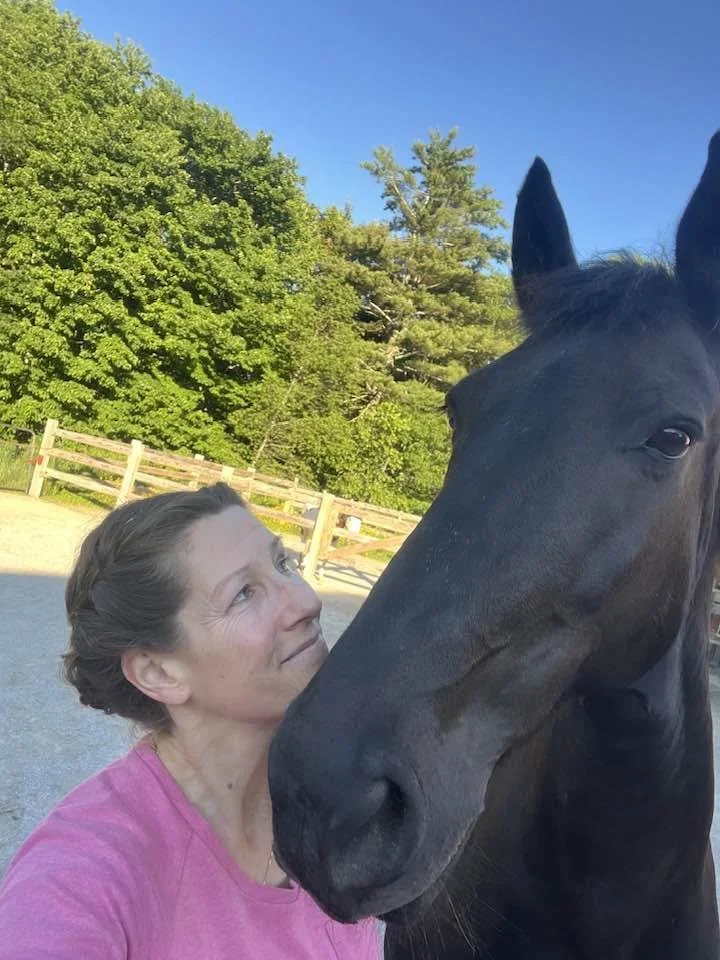
“You don’t power over your horse; instead, you ask patiently, listen, and ask again.””
It’s a slow process, but it builds a stronger, deeper connection than other training methods I’ve tried. With clicker training, you open up two-way communication. You don’t power over your horse; instead, you ask patiently and listen, and ask again. The horse gets to choose if they want to do the request. They can opt out with no harsh punishment, or they can opt in and give it a try. That’s all we’re asking of our horses.
For example, we ask: Can you try targeting this? Can you walk over the tarp? Can you weave between the cones at liberty without us touching? Can you lower your head in the canter and relax when we are at liberty? Can you soften into the bridle? Can you flex left, flex right? Can you move your shoulders in more? Can you balance in your body better this way? Can you trot bigger but stay balanced? Can you bend and flex in the circle?
These are some of the questions I ask of Jackie and the horses I work with. These questions are purposefully asked so that the learner can respond with a “Yes, I can” or “I can try.” In my training, I don’t push and shove. I ask nicely, and nicely again. None of this nonsense training where the rider asks once nicely, then harsher the second time, then a smack the third time. That’s not needed. Horses are smarter than that and should be better respected, and as a horse industry, we need to reshape the way we work with horses by showing riders there’s a kinder way.
If my horse doesn’t want to, or thinks they can’t do what I’m asking, we just go to another exercise that may be easier, or an exercise that may build confidence so that when I ask the harder “Can you?” they say, “Oh, I can!” I also am assessing my asking skills because sometimes I may need to be more clear.
When working with horses using positive reinforcement, you condition the horse to understand that the responses are rewarded with a treat, and isn’t that nice? Horses don’t always do what you ask just for treats. They do it because a positive feeling also erupts after the treat—endorphins flow, and as a result, the horse’s brain is calmer and ready to answer the next question.
My question for YOU is: Why not try positive reinforcement training with your horse? Why not open yourself and your horse up to new possibilities and conversations that you can’t even imagine may happen?
I have seen some profound changes in my relationship with this gal, who had a rough start, and I’m so pleased with her willingness to try with me. It is very important that she understands we can trust each other, and my job is to uphold that standard and to be mindful of how we do that.
Also, my job as a trainer is to keep her brain in a responsive state versus a reactive state. Horses move fast and are dangerous when they are in a reactive mode. I don’t need to be a part of that conversation, thank you. I’m not a fan of that type of training anyway; it’s just a quick fix.
If my training resonates with you and you want to learn more, please share and reach out to me directly, as I am offering clinics this fall and would love to share the beauty of R+ training. You can come to my farm with your horse, or I’ll come to yours and work with a group. Let’s get going with changing the world of horse relationships and training, one click at a time!
I am Alexandra Mackenzie Doan, owner and trainer at Moose Ridge Farm in Lincolnville, Maine. My business is Dressage Clicks, but I can work with other disciplines. I offer liberty sessions, under-saddle work, and bitless training. My clinics are fun, insightful, and, of course, rewarding to all!!